
Eden Richter · 11 November 2026
Charting Synchronization Protocols Across Multi-Tool SEO Environments and Their Influence on Metric Accuracy During Peak Data Loads
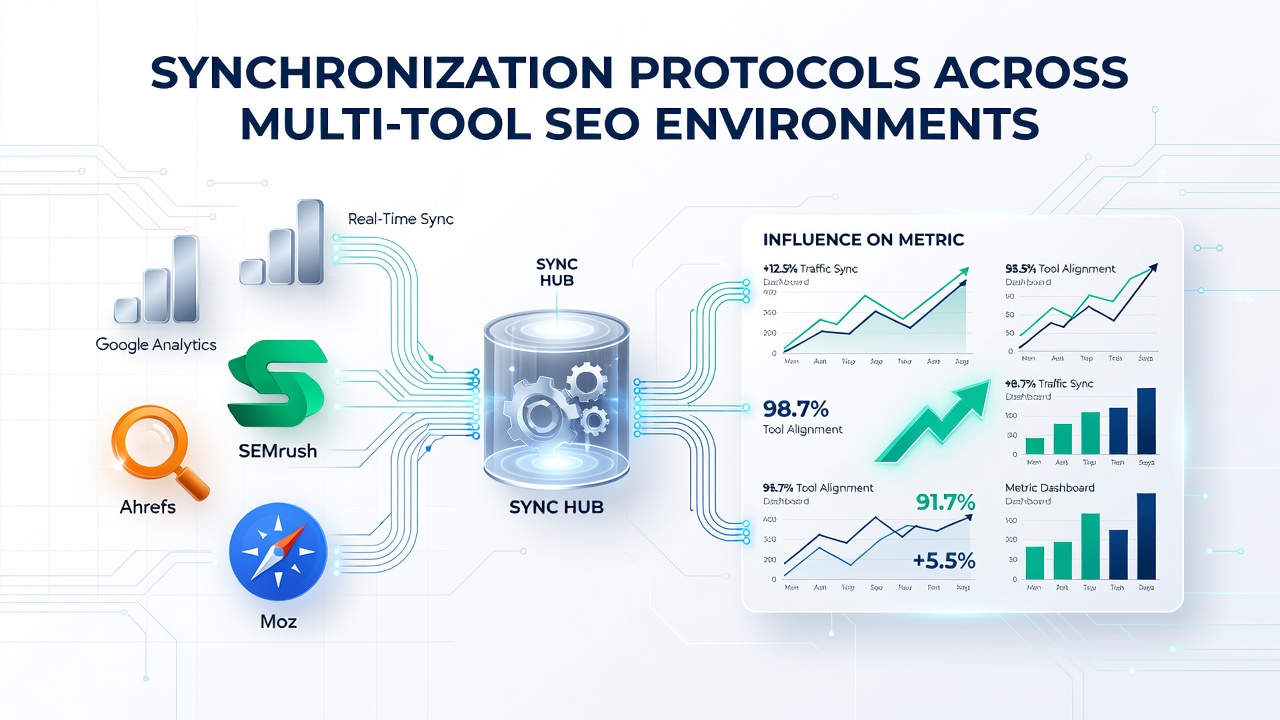
Multi-tool SEO environments combine platforms such as crawling software, ranking trackers, backlink analyzers, and keyword databases, and these setups require synchronization protocols to align datasets pulled from different APIs and storage systems. Protocols handle timestamp matching, conflict resolution, and incremental updates so that metrics like organic traffic estimates, position changes, and visibility scores remain consistent across tools. During peak data loads, which occur when campaigns launch new content clusters or when search engines release broad updates, the volume of API calls rises sharply, and any lag in synchronization can shift reported numbers by several percentage points within minutes.
Core Components of Synchronization Protocols
Protocols in these environments typically rely on event-driven queues that process incoming data streams in sequence, while checksum validation confirms that transferred records match source outputs before they merge into central dashboards. Researchers at institutions focused on distributed systems have documented how protocols incorporate retry mechanisms with exponential backoff to manage rate limits imposed by external providers. In practice, one protocol might poll ranking data every fifteen minutes while another ingests log file entries in real time, and the system must reconcile these differing cadences without overwriting fresher values. Data from the Statistics Canada digital economy reports shows that organizations handling high-volume queries experience throughput drops of up to thirty percent when multiple tools request overlapping datasets simultaneously.
Effects of Peak Loads on Metric Consistency
Peak loads often coincide with seasonal events or algorithm refreshes, and in November 2026 several monitoring services recorded sustained query volumes exceeding normal baselines by forty percent for consecutive days. Under these conditions, synchronization delays can cause position metrics to display stale rankings for hours, while traffic estimates diverge between tools because one platform receives updated crawl data before the other completes its merge step. Observers note that accuracy degradation appears first in granular segments such as mobile versus desktop splits, where small timing mismatches compound into larger discrepancies. Protocols that use vector clocks or logical timestamps help detect these ordering issues before they propagate, yet implementation varies widely across commercial offerings.
Protocol Variations Across Commercial Platforms
Some platforms employ REST-based polling with strict pagination rules, whereas others integrate webhook notifications that push changes as soon as source systems detect them. Those who manage enterprise accounts frequently observe that webhook approaches reduce latency during spikes but require additional authentication layers to prevent duplicate entries. Studies conducted by research groups examining large-scale data pipelines indicate that hybrid models combining both methods maintain higher consistency rates when traffic surges exceed predefined thresholds. In one documented workflow, a European analytics provider combined incremental sync jobs with nightly full reconciliations, and this approach limited metric drift to under two percent even when daily API calls tripled.
Measurement Techniques for Accuracy Assessment
Teams evaluate accuracy by comparing overlapping data points across tools at synchronized timestamps, then calculating deviation scores for key performance indicators. Automated scripts run these comparisons every hour during normal periods and every five minutes during anticipated peaks, flagging any variance above a set tolerance. Evidence from distributed computing literature demonstrates that sampling strategies which focus on high-velocity metrics, such as real-time ranking shifts, provide earlier warnings than uniform random checks. When deviations exceed thresholds, operators can trigger manual audits or adjust protocol parameters such as batch sizes and concurrency limits to restore alignment.
Scaling Strategies Observed in Practice
Organizations scale synchronization capacity by distributing workload across regional data centers and employing sharded databases that isolate traffic by project or geography. This segmentation prevents a single overloaded queue from affecting unrelated campaigns. In addition, caching layers store recently synchronized records so that repeated queries do not trigger fresh API calls during brief load spikes. Figures from industry benchmarking initiatives reveal that setups using these combined techniques sustain sub-second query responses even when total data ingestion rates surpass several thousand records per second.
Conclusion
Synchronization protocols form the backbone of reliable metric reporting in multi-tool SEO environments, and their behavior under peak loads directly determines how closely displayed numbers reflect actual search performance. Continued refinement of timestamp handling, conflict resolution, and load distribution methods supports more stable outputs as data volumes grow. Those responsible for tool selection and configuration benefit from ongoing monitoring that quantifies accuracy drift before it affects decision-making processes.